
Come and visit us at Huttons Ambo, a beautiful, ancient rural village located between the City of York and Malton - both of which are hotbeds of amazing archaeology.
The History
The village of Huttons Ambo is about 14 miles (22.5km) north-east of York and 3 miles (4.8km) southwest of Malton. It consists of the villages of High Hutton and Low Hutton.
The villages are mentioned in the Domesday Book as Hotun in the Bulford Hundred. The lands were divided between Cnut, son of Karli, Thorkil, and Thorbrand, son of Kalri. After the Norman invasion, the lands were split between the King and Berengar of Tosny.
The land at Low Hutton, owned by the King, has been named Hutton Colswayn, whilst the land near Hutton Hill has been known as Hutton Mynchon. The land at High Hutton has been known as Hutton Bardolf. All these suffixes indicate the names of the landowners of those times. The Colswayn family may have been given the land by the Crown for duties performed guarding York Castle. The titles then passed on to the Bolton family.
The other lands came into the possession of the Gower family, some of whom held the office of High Sheriff of York, such as Sir Thomas Gower. Memorials to members of this family can seen in the church.
The name Hutton derives from the Old English ‘hōh tūn’, meaning ‘settlement on or by the hill spur’. Ambo, the suffix, is Latin, and refers to the combination of the two villages into one parish.
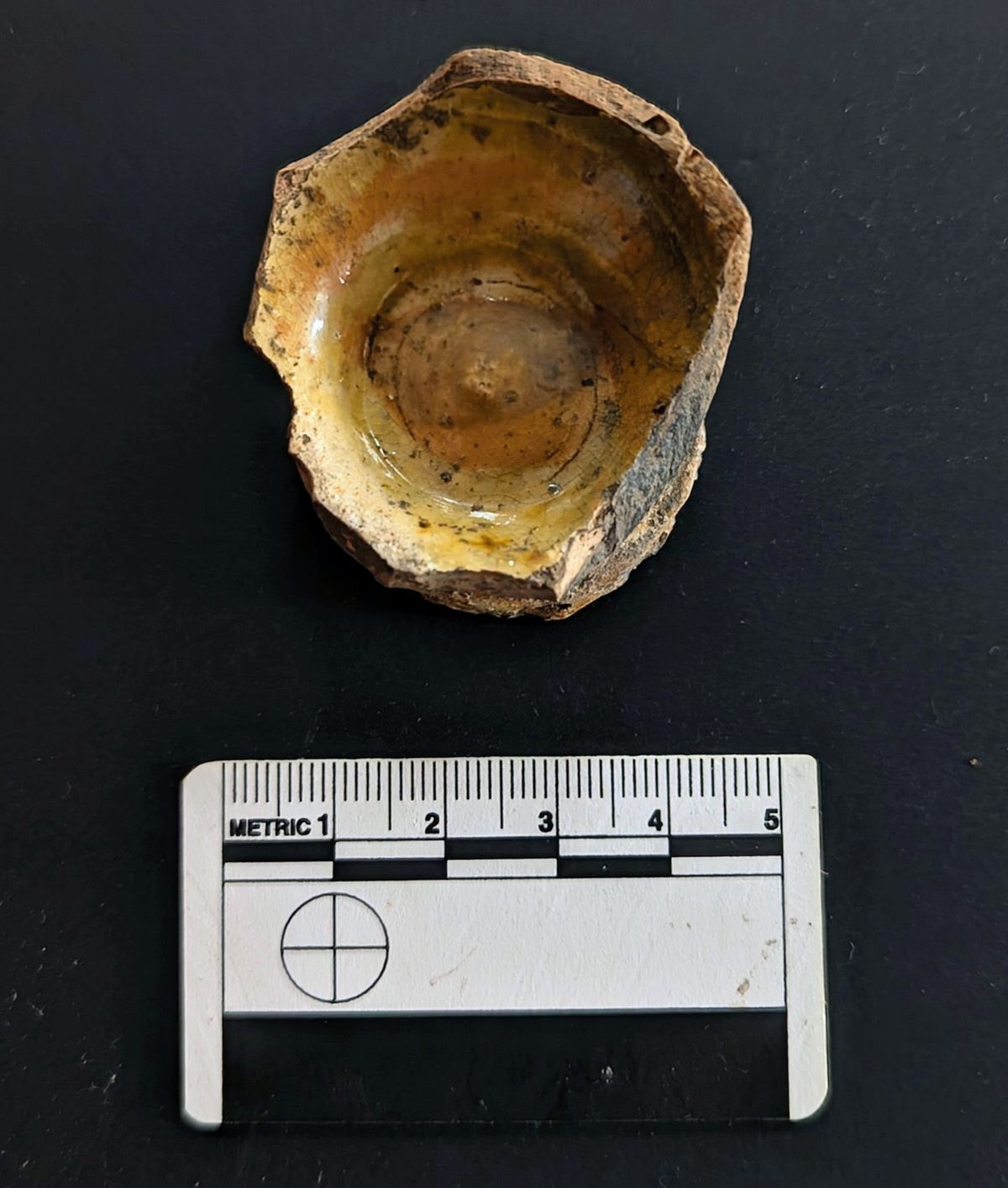
Huttons Ambo also lends its name to a specific type of Medieval pottery produced here in the 13th century, consisting of large, unglazed storage jars. It is a short distance to the major Roman potteries at Crambeck. The excavations hope to cast more light on the Huttons Ambo pottery industry and its location.
The project will provide participants with a unique opportunity to investigate a village that dates back over 6,000 years and is recorded in the Domesday Book. The project will be carried out using the most up-to-date archaeological techniques available, under the supervision of experienced and highly qualified archaeologists.
Recent excavations carried out by Ethos Heritage CIC uncovered significant amounts of Iron Age and Roman pottery in addition to burnt daub. These indicate a possible structure that appears to have been identified in the geophysics survey carried out in the village in 2023.
A large ditch and bank were also identified and a trench was placed inside it in July 2024. This uncovered large amounts of Iron Age and Roman pottery, dating from 75 BCE to 300 CE. In addition, large circular pits were also identified, suggesting that a Romano-British feature lies within this bank and ditch.
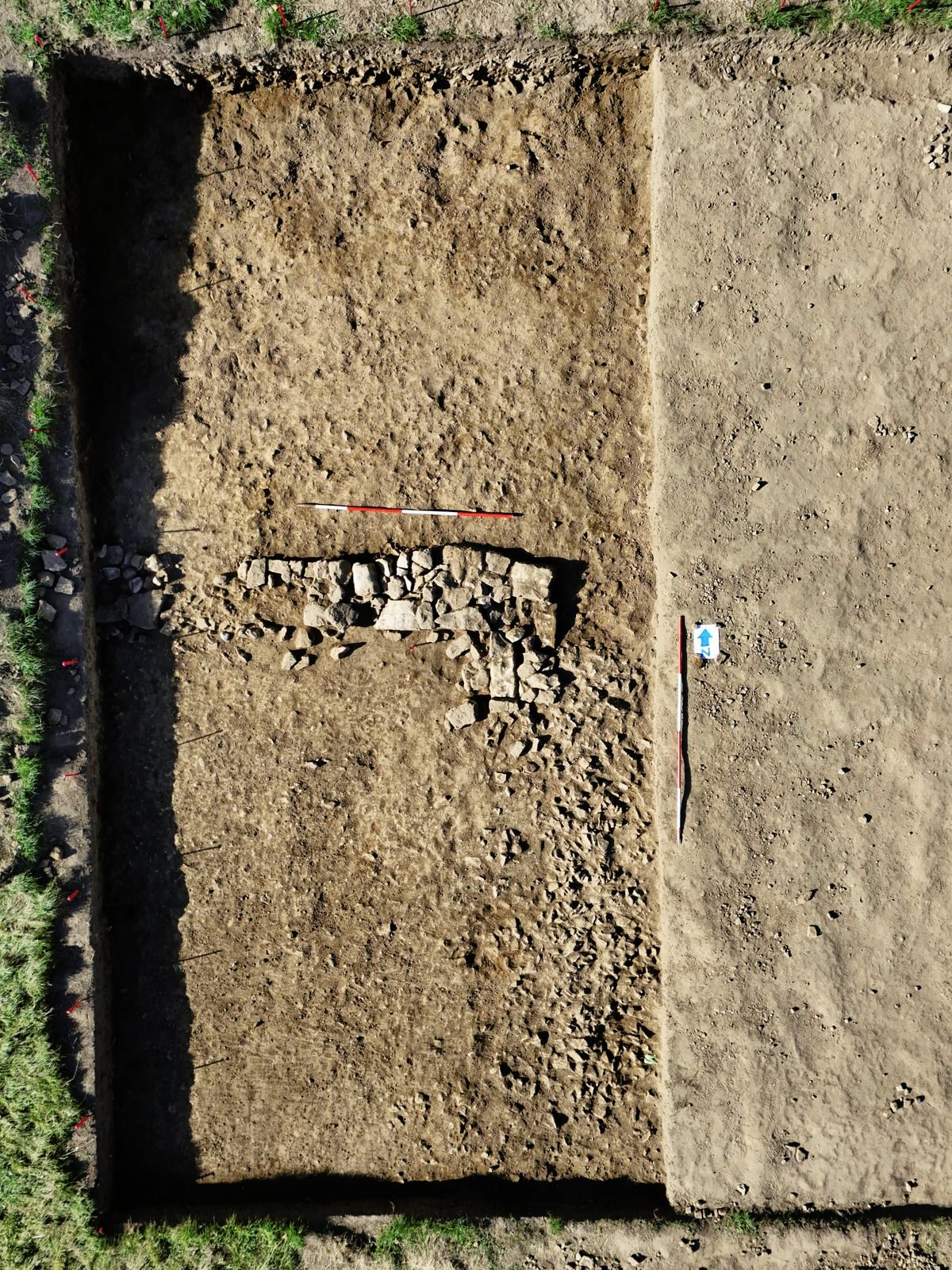
One of the most striking features was the discovery of a large masonry structure that appears to date from the 16th-18th century, which has reused stone from an earlier building including a 13th century window arch.
A surprise for all concerned was the discovery of a substantial Medieval stone building at the top of village, which - from the associated pottery and artefacts - we can date to the 13th century. In conjunction with these remains, we found a line of large post holes associated with burnt daub: this would indicate the previous existence of an associated wooden structure which has burnt down. The fact the post holes and the wall of the structure are parallel to one another indicates they are associated with each other and possibly of the same date.
Project Objectives
The focus this year will be on the following:
1. Investigation of the large building which we believe dates to the 16th century, made up of reused stone from an earlier building (possibly dating to the 13th century).
2. Investigation of the bank and ditch that surrounds a possible Romano-British feature.
3. Continued excavations of the Medieval stone building, which may represent a further manor house within the village.
4. Continued geophysics survey of the parish using a variety of techniques.
It is hoped that these investigations will allow continued assessment of the significance of Huttons Ambo, and its potential for further exploration, on a site of regional importance.
Location
Huttons Ambo, The village Hall, Huttons Ambo, North Yorkshire, YO60 7HJ, United Kingdom
Additional location/direction information
Meet at village hall and guides will walk you to the excavations 3 mins walk
Schedule
Sat, 26 Jul
11:00 AM
|
2:00 PM
Sun, 27 Jul
11:00 AM
|
2:00 PM
Duration of event
Two days for the open day