Archeology in the archives - Wakefield post-war houses the death-knell of domestic drudgery?
Archaeologists don’t always work outdoors. Sometimes we get to spend time digging (metaphorically) through museums and archives collections, which is always a lot of fun. I’m always amazed how these collections have as much capacity to yield unexpected discoveries as outdoor fieldwork does, as happened this week in Wakefield.
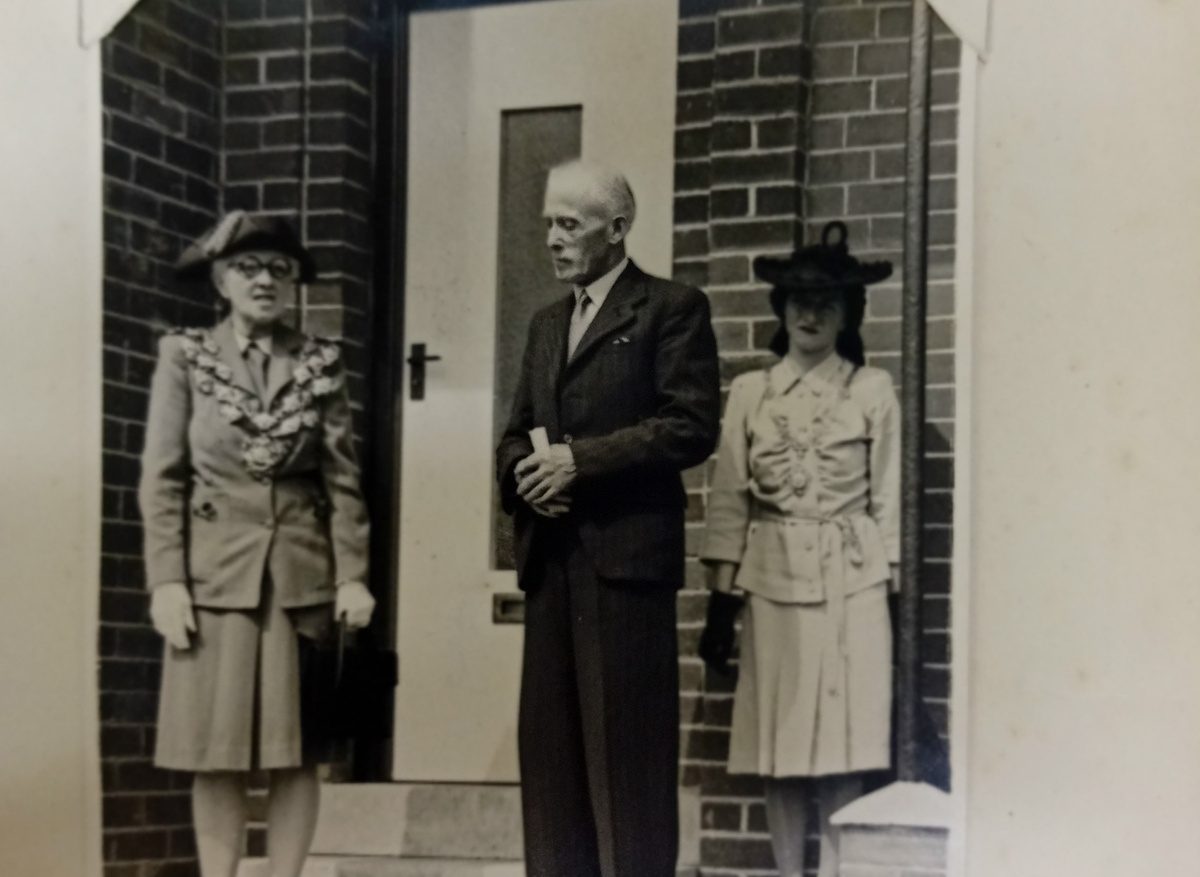
This week I’ve had the pleasure of digging through the Wakefield Local Studies collection with colleagues from Wakefield Libraries and Wakefield Museums and Castles. Whilst looking through the collection we came across a photo of former Lady Mayoress, Mrs Ashton, at the opening of ‘demonstration houses’ in Wakefield in 1946. We initially assumed these houses were the start of the new post-war housing estates that were built in Wakefield, including in areas like Lupset. However, further research has uncovered a slightly more complex and interesting story.
A newspaper article in the Bradford Observer on Wednesday 10 July 1946 describes the opening of a demonstration house on the Winterbourne Estate in Morley, and two similar houses on Cyprus Mount in Wakefield. The houses were built by J S Bramley and sons Ltd. of East Ardsley to a ‘winning design’ by architect Mr A Binks. They were constructed in co-operation with the Ministries of Health and Works at a cost of £1200-£1300 per property. The article goes on to describe the houses as ‘the death knell of domestic drudgery’ and ‘draught proof and dust dispelling’ and says they will be open ‘for Yorkshire housewives to inspect’ for three months, with 26 other pairs of permanent prototypes planned to be built around the rest of the country. The article goes on to describe the houses’ innovative air convection system that drew air from outside, passed it over a gas combination grate and then circulated the (now warm) air through the upstairs bedrooms. The writer then raises the question of whether local private builders or Government are better placed to deliver new housing, an ongoing discussion that still has a lot of resonance today!
Another article was published the following day in the Yorkshire Post and Leeds Intelligencer. This article says the ‘furnished exhibition houses’ in Wakefield and Morley were sponsored by the Council of Industrial Design in collaboration with the Leeds Regional Office of the Arts Council, as the result of a competition organised by the House-building Industries’ Standing Committee. The article goes on to describe the exhibition as ‘a practical demonstration of what can be achieved in days as drab and discouraging as these towards the creation of a gracious home environment’. It also suggests that the houses will contribute to overseas British trade, by ‘cultivating a wider public understanding of the benefits of good design’.
Interestingly the design of the interiors was overseen by a woman, Miss Theo Moorman, assistant regional director of the Arts Council. She was born in Leeds and trained at the Central School of Arts and Crafts in London. A notable textile artist in her own right, she worked for the Arts Council from 1943 to 1953. Her textile work, which she continued to produce into her late eighties, can still be found in churches across the country, and a trust set up after her death now offers grants to support young weavers in the early stage of their careers.
The photograph of Mayoress Ashton therefore gives us an unexpected window into an overlooked period in immediate post-war urban development, involving many of the main players of the time. Many of these organisations still play an important role in promoting access to art, culture and high-quality design as something everybody should be able to enjoy, and their role in developing housing models is illuminating. It was also a time when local private developers were having to justify their role in the provision of housing for local communities, something we might find hard to imagine these days.
The Design Council was created in 1944 by Winston Churchill’s wartime government to tackle post-war economic recovery. It’s first mission was “to promote by all practicable means the improvement of design in the products of British industry” (Design Council website). Over the following decades, the Design Council became the national strategic advisor for design. In 1944 the Design Council set up the Council of Industrial Design. In autumn 1946 they organised the ‘Britain Can Make It’ exhibition at the Victoria and Albert Museum, promoting their vision that good design was the key to driving growth in British industry and improving people’s everyday lives. The demonstration houses in Wakefield pre-date this by a few months and show that the Design Council was already supporting work to promote its vision in other parts of the country, including West Yorkshire.
A series of new housing acts were passed during the 1940s and 1950s. These acts established new powers and standards for local councils to provide new housing estates, and even new towns, to address the urgent housing need across the country. The demonstration houses in Wakefield were created at an early stage in this post-war housing boom and show that West Yorkshire was embracing creative and innovative housing design before national standardisation, with women playing a key role in the process.
Sadly, it appears that the houses on Cyprus Mount no longer survive. The new road was developed in the late 1940s as part of a new housing estate of spacious semi-detached properties on the edge of the city centre. The 1948 Ordnance Survey shows new building plots under construction all the way along the road (which is unnamed on the map). More research is needed to establish exactly where the demonstration houses were located, and what happened to them after 1946, but the research so far shows how unexpected discoveries can emerge from a quick dig in the archives, and how a single photograph, and some more archive digging, can change our understanding of the development of our built environment.
If you have any information about the demonstration houses on Cyprus Mount, we would love to hear from you. Please contact us at heritage@wakefield.gov.uk.
This research is connected to a wider project researching the stories connected to Wakefield's civic artworks, supported by the Wakefield Historical Society Research Group. It is worth noting that Mayoress Ashton is accompanied at the opening of the houses by Wakefield's second female mayor, Mrs E Crowe. We are planning to tell more of their shared story in due course. To find out more about the Civic Art project please visit the Wakefield Museums and Castles website (link below).