Casefiles - Liverpool Street Station: A light at the end of the tunnel?
As keen readers may remember, controversial plans to refurbish Liverpool Street Station have been under discussion for several years. The station is a masterpiece of Victorian transport infrastructure, including a grand statement hotel and wide, airy concourse, with sensitive 1980s refurbishments.
The Council for British Archaeology are part of the Liverpool Street Station Campaign (LISSCA), led by the Victorian Society, which is campaigning for a sensitive refurbishment scheme.
LISSCA succeeded in achieving a widely celebrated heritage-led scheme for the station in the 1970s and 80s after campaigning against initially harmful proposals. In the 2020s, the campaign group reformed to campaign again, and it seems that a better future for the station may finally be within reach as a new set of ideas have been put forward.
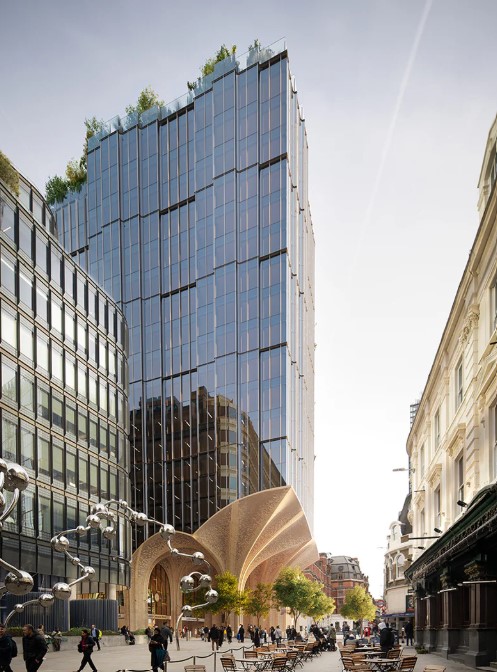
An initial proposal (application 23/00453/FULEIA), put forward by Sellar and Herzog & de Meuron in 2023 without any prior discussion with Historic England or the National Amenity Societies, was widely criticised for its proposal to erect a large tower block above the station. The 21-storey high tower would have been supported on large columns driven straight through the centre of the Grade II* listed Great Eastern Hotel and would have totally dominated the historic street scene and harmed the Bishopsgate Conservation Area.
In 2025, a new proposal (application 25/00494/FULEIA) was submitted by National Rail and ACME. The new plans slightly reduced the scale of the proposed tower (now 20 storeys tall) and avoided cantilevering the supports through the hotel, but the principle of a large new tower above a listed building – especially a listed building with a historic glass roof – is still highly controversial.
At the time of writing, both the Sellar / Herzong de Meuron and the National Rail / ACME planning applications remain live on the City of London’s planning site, leading to considerable confusion.
The historic area around the station was deliberately excluded from the ‘Tall Building Zone’ areas in the City of London Plan, because of the surviving nineteenth-century street scape and scale of the existing structures, so the principle of a new tower block is already on very shaky ground.
The justification put forward for the big new development above the station was the need for all station improvements to be self-funding. The scale of the tower was argued to be the minimum needed to fund the accessibility and permeability improvements which are certainly needed.
Unfortunately, National Rail’s proposed scheme is not technically economically viable, and relies on demand for rental office space increasing – a bold gamble in an era of increasing hybrid or remote working.
The costs of the scheme also include a number of alterations which are neither of heritage or transport benefit, including the construction of new retail and food spaces within the station. While these would increase National Rail’s long-term income from the site, LISSCA doesn’t believe that the cost of extra shopping spaces should be funded at the expense of the listed building.
Now a brighter future for Liverpool Street Station may be on the horizon, as a third option for the station’s future has been put foward which aims to work with and enhance the station’s existing monumental historic architecture.
John McAslan + Partners (JMP) are the architects who designed the exceptional refurbishment of King’s Cross Station in 2012, and a number of other successful transport projects, including Belfast Central Hub in 2024 and the Central Station for Sydney’s metro in 2023. To create an alternative scheme for Liverpool Street Station, they partnered with Expedition, engineers of the 2012 Olympic Velodrome.
JMP’s designs focus on delivering high-quality office space in a way which respects the existing architecture of the station and avoids any permanent harm: the whole new structure could be removed at a later date without leaving any trace.
While some building above the station would be necessary to fund the project, the elegant design would sit above the end of the train concourse, minimising its visibility from the wider street scene. The arched roof reflects the architecture of the railways and Exchange Square adjacent, complementing the site instead of overwhelming it.
The light-touch construction approach would drastically reduce the impact on station users by minimising the impact of the building works on the railway. It would also be a low-carbon option, thanks to efficient engineering, materials with a long lifespan and reusing existing buildings where possible.
By offering innovative, high-quality office space, the rental income is increased without having to increase the required floor space, so only nine additional floors would sit above the concourse. Public walkways above the station and a new public garden at the northern end of the concourse would allow better public access to the station and appreciation of its architecture from above.
It is estimated that the JMP scheme could be delivered at about half the predicted £1.2bn cost of the schemes currently under consideration, while still delivering the same accessibility and capacity upgrades, including escalators, lifts, waiting areas, toilets and a cycle hub.
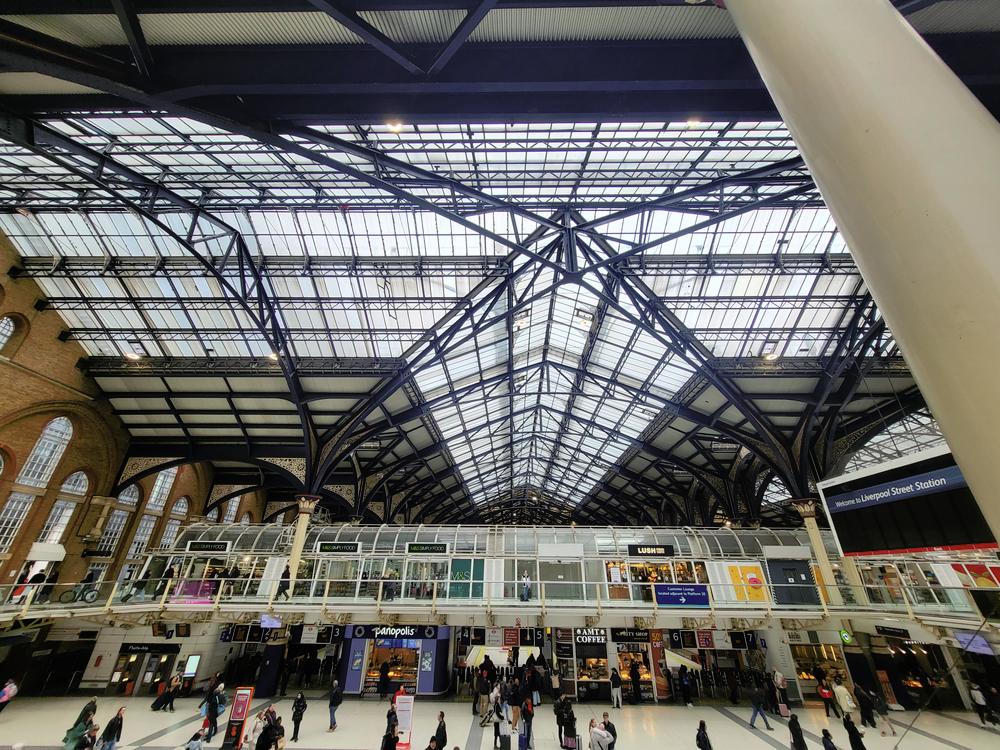
John McAslan, founder of John McAslan + Partners (JMP), said: “At Liverpool Street Station we seek to embrace the past, present and future in a way that celebrates transport architecture by retaining and protecting the station’s historic fabric and also future-proof it – an approach we adopted at King’s Cross Station.
“Importantly, our emerging ideas for Liverpool Street Station are proportionate in scale to the existing structure and aligned with the level of additional development required to finance the station’s upgrade.
“Our approach is phasable and will ensure Liverpool Street Station remains operational with minimal disruption during its construction period. Thanks to our team’s ecologically led fabric-first design approach which embeds our practice ethos of ‘enoughness’, we do no more than is needed to deliver a successful outcome for the station and its passengers.”
The JMP design has been welcomed by heritage bodies, including SAVE Britain’s Heritage, the Victorian Society, and the Twentieth Century Society. With a heritage-led, minimally disruptive, cheaper and more carbon efficient option on the table, can Network Rail justify pursuing their current unpopular design?