
Knitting Dartmoor’s soils
My PhD research on Dartmoor, a national park in southwest England, set out to explore the region’s Mesolithic hunter-gatherers through the study of lithic scatters. Using predictive modelling and targeted test-pit excavation, I focused on how Mesolithic people moved through this granite upland, where they paused, and what the distribution of lithic scatters might reveal about how they lived, acquired, and passed on environmental and social knowledge. Soils are a silent archive beneath our feet, recording thousands of years of environmental change, and some of my work depended on understanding the formation of soils and their capacity to preserve traces of activity.
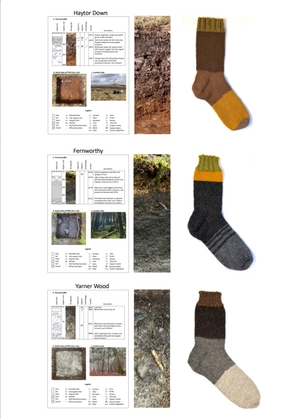
Working alongside a team of National Park volunteers, our excavations revealed new areas of hunter-gatherer activity in the form of lithic scatters – and a striking variety of soil types. These included podzols with pronounced horizons, granitic layers on exposed moorland, and rich black peaty soils. To a geoarchaeologist, these different soil types help explain why we might encounter stone tools in some places and not others. But to a wider audience, soil types can feel abstract and technical.
So I knitted them.
I knitted three pairs of socks, each representing a soil type encountered during excavation. Colour bands marked the horizons, and, where possible, I selected yarn textures that reflected grain size. The idea was light-hearted: a playful translation of geoarchaeology into something tactile and tangible. I imagined they might amuse people at outreach events, but I was surprised by the depth of conversation they sparked – conversations that my stratigraphic diagrams and sediment logs never quite managed.
People asked why some layers were pale and others dark, and how soils formed on Dartmoor. Many connected the colours to their own walks on the moor: ‘I’ve seen that gritty layer on the way up to Haytor Rocks,’ one person said. These conversations gave me the opportunity to explain how past vegetation cover influenced the soils, how this may have shaped hunter-gatherer lifeways, and the extent and distribution of Dartmoor’s lithic scatters.
Artistic engagement, in this case, made the invisible visible. My socks became a more effective bridge into my research than data alone ever could. They opened conversations and helped me tell the story of Dartmoor’s past in an unexpected way.
And they kept my feet warm.