
Lifeless things? Archaeological roleplay in Nothing Beside Remains
There is an emerging genre of puzzle video games that require players to come up with theories based on material evidence in the environment. Heaven’s Vault, a sci-fi game in which you play as an archaeologist deciphering an alien language, is an obvious example. Tale of the Obra Dinn is set in 1807 and directs you to solve murders on a ship using a pocket watch that recreates the moment of death. Then there’s Outer Wilds, in which you explore an interplanetary system stuck in a time loop, while also interpreting the ruins of an ancient civilisation. More recently, Blue Prince has you try to reach a hidden location in a mansion with rooms that shift every day, with their contents providing clues to the mystery.
These games use environmental storytelling, a design technique common to video games for conveying narrative through content in the environment. In my work I argue that environmental storytelling invites players to roleplay as archaeologists, interpreting material traces in the game world. As there has been limited empirical work on how and on what basis players interpret environmental storytelling, I conducted a player study in which 202 participants played a game I co-developed with Mike Cook: Nothing Beside Remains.
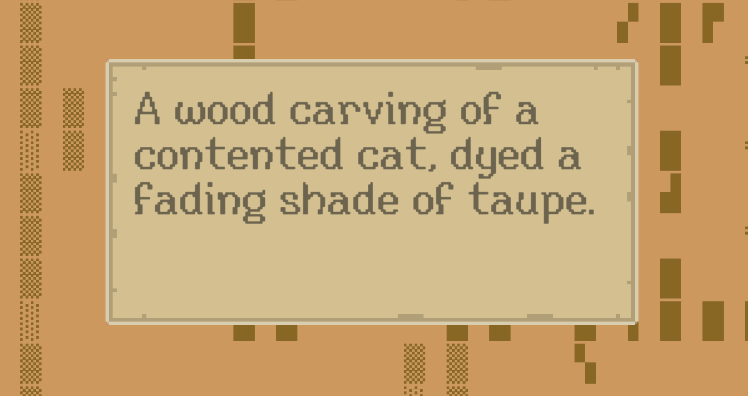
Nothing Beside Remains is a 2D, single player exploration game set in a ruined village. The game uses procedural generation, with some content created algorithmically according to constraints that we designed (it should be highlighted, this is not generative AI!). The game has no end goal; you are simply invited to explore, with the option to read short item descriptions by interacting with objects.
We had participants answer a series of questions about their playthroughs, such as what they thought had happened to the village. In the subsequent analysis of their responses, we came up with the theory of an ‘archaeological gameworld mental model’. Players form a mental model of the gameworld based on the material evidence they find in the game, and this mental model can be supported through recording methods such as note-taking, map-making, or photography – all methods used by analogue archaeologists.
We hope to extend this research, investigating the educational potential of game design that engages with archaeological method and theory. We will also explore how it might be used to preserve the fleeting play experiences of contemporary games that will be inaccessible to future audiences.
Delve into this topic in more depth in the open-access paper ‘Archaeological Gameworld Affordances: A Grounded Theory of How Players Interpret Environmental Storytelling’, co-authored by Florence Smith Nicholls and Michael Cook: https://bit.ly/GameworldStudy