Can you help Holy Trinity to ‘Keep the Gate Open’?
Holy Trinity, Goodramgate, is a special treasure amongst York’s hundreds of churches. Like many its built fabric is a tapestry, evidencing its phased development over centuries. The mixture of windows, blocked openings, the addition of chapels, aisles and arcades reflect the swelling and shrinking of its congregation as well as parishioners’ expressions of devotion (or public displays of wealth) through embellishments to and within the built fabric of this parish church.
Unlike the majority of churches which date back to the 12th century, Holy Trinity remained untouched by the heavy-handed 19th century trend of ‘restoring’ early medieval churches. Holy Trinity retains its 17th and 18th century box pews and has never had electric lighting. Walking through the door is like stepping back into a past era.
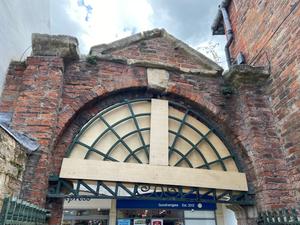
The small churchyard of Holy Trinity is an oasis of calm, hidden from view behind the bustling shopping street of Goodramgate, with the Minster towering behind it. The entrance gateway is a 17th century red brick arch with sandstone dressings and early 19th century cast-iron gates, that is itself Grade II* listed. Sadly, the gateway has not fared well over recent decades. When the soft red bricks have shown signs of age and wear, cracks have been filled with cement-based mortar which has exacerbated and accelerated the gateway’s structural issues. This is a common issue which the CBA’s casework team often encounter.
The industrial production of cement, as a building material, was developed in the early 20th century and heralded as a robust and durable material that would wear well. This must have been so appealing at a time when the lime-based products that preceded cement had a finite lifespan. Over time lime mortar and weather coats degrade and need replacing. Cement based products presented a ‘just do the job once’ efficiency saving. Cement does weather well, but in old buildings that is not always a good thing. Cementitious materials are so durable that when rain, frost, ground moisture and seasonal temperature variations are experienced, adjacent traditional building materials like stone, wood, old bricks, etc sacrificially decay. Because cement is so much more durable than the older softer materials, they decay around the mortar. Can you think of a hollowed-out wall, where the mortar is proud of the stone / brick? This is what has happened.
Well intentioned repairs to Holy Trinity’s gateway now risk resulting in loose and falling masonry, which has necessitated the temporary structural support and a campaign to raise £30,000 for conservation works. If you are in a position to help, please visit the Churches Conservation Trust’s fundraising page - Keep the Gate Open at Holy Trinity (Goodramgate), York.
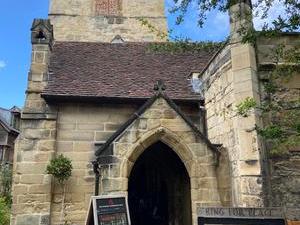
Many city centre parish churches lost their congregations as residential occupancies above retail outlets diminished. Holy Trinity has been redundant and cared for by the CCT since 1972, who work hard to keep the building open and available to visit.
It has been a place of peace and devotion for centuries, becoming recognised more recently as where Halifax diarist and businesswoman Anne Lister "married" her partner, heiress Ann Walker, on Easter Sunday in 1834. Although same-sex marriage was not legal at the time, Lister and Walker took the sacrament together at Holy Communion and considered themselves wedded. In 2018, a rainbow plaque was unveiled at Holy Trinity in their honour, the first LGBTQ+ history plaque to be put up in York.
Holy Trinity, Goodramgate want to keep the gate they walked through open for present and future generations to access this quiet oasis of calm from the city’s noise for a moment of quiet contemplation and peace. If you can help them do this, please consider donating to their appeal.