Sense-able dagger research
Archaeology is sensational! From the smell of newly-trowelled earth and the feel of different ancient materials to the musty air of archives, archaeological work affects the senses. However, formal research reports focus on only one sense: sight. What might we learn by reporting archaeological research in a multi-sensory way?
The inspiration to experiment with a multi-sensory approach and a spoken research narrative came from the work of The Sensational Museum. Their aim is for 10 of the human sensory systems (sight, sound, smell, taste, touch, temperature, balance, pain, internal bodily awareness, and external bodily awareness) to be equally represented in museum descriptions. And you thought there were only five senses, right?
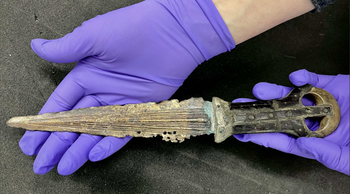
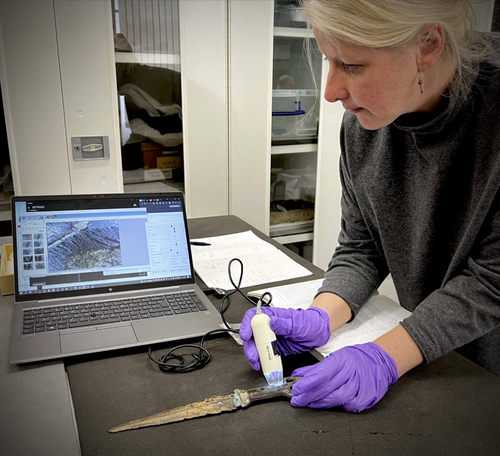
In February 2023 I visited the Garstang Museum of Archaeology at the University of Liverpool to research an Egyptian-Nubian dagger (E.1529). I was there to measure the dimensions of the object and read its chemical composition using portable X-Ray Fluorescence. As an object-type, daggers are known for their ‘stabby-ness’, but hidden behind their more obvious visual meaning are the intriguing social aspects of their manufacture.
In Egypt and Nubia around 1700 BC daggers were placed in some people’s graves by their family and friends. These daggers show broad crafting expertise and technological knowledge, and the dry sand of the ancient Nile Valley has preserved organic handle materials as well as metals. However, not all blades survive being taken out of tombs. The jagged edges and holes in the Garstang Museum’s dagger blade show that it suffered Bronze Disease during its post-excavated life: a bubbling, powdery corrosion that can devour copper-alloy objects in mere months.
There is more to archaeology than meets the eye. To make a blade, painful hours were spent crushing the ore, followed by minutes of skin-searing heat when pouring the molten metal into its mould. In the museum workroom the coolness of the blade is easily felt through my gloves and lingers after I remove my hand. In comparison, the silky smooth hippo-ivory pommel and wooden handle are comfortably warm to the touch. The weight of the dagger balances at the blade-guard, a truncated pyramid of grainy plaster pressed into shape by ancient fingertips. Did the same hand tap in the handle’s rivets accompanied by the resonant tones of a wooden mallet or the high-pitched tinks of a stone hammer?
Engaging a range of senses when interacting with ancient objects reveals many hidden, social aspects of ancient technology.